Fitness design for mental health
Published by HealthFitness on June 2nd, 2026
Across industries, exercise is increasingly viewed as essential mental health support — not just physical training. Employees are describing wellness spaces as opportunities to decompress, reset, and manage stress during demanding workdays. Especially in high-pressure environments like health care systems and manufacturing operations, structured fitness programming is directly supporting resilience and burnout prevention.
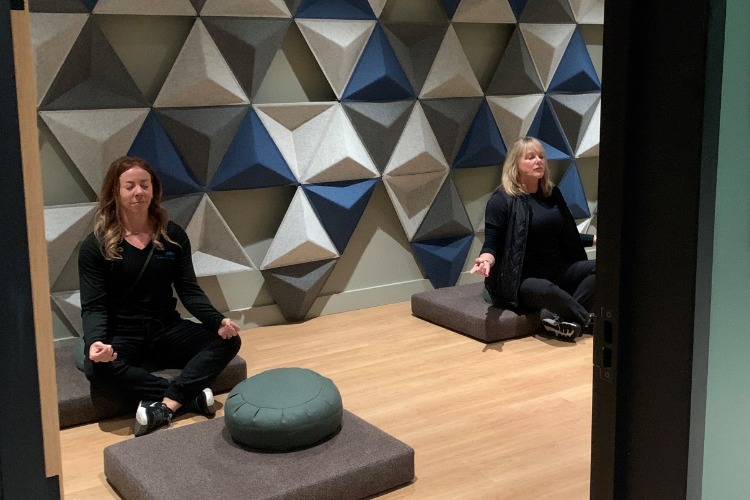
Employees consistently tell us that fitness challenges are “the best part of the day,” on-site workouts provide much-needed pauses during intense work, and group classes offer both stress relief and social support. In many facilities, our sites are evolving into spaces for decompression, connection, and emotional resilience.
What this looks like in practice
In organizations where this trend is strongest, mental health and movement are not siloed. They’re integrated into the rhythm of the workday.At many sites, structured group classes like yoga, breathwork, or mindful movement are scheduled throughout the day rather than only before or after work. This acknowledges that stress doesn’t only happen outside normal hours. Employees can drop in between meetings or during natural lulls in their schedule with managerial support and cultural permission to do so.
Some organizations have adopted the mentality that employees should take a break “whenever their schedule allows” rather than confining wellness to designated time blocks. Leaders actively communicate that stepping away from a desk for a mental reset is encouraged and productive — part of a culture of wellbeing rather than a perk.
Some organizations are reinforcing this shift through space design. In addition to traditional fitness centers, they are creating dedicated meditation or mindfulness rooms, quiet recovery spaces with soft lighting and minimal technology, and stretching and mobility zones separate from strength areas.
These spaces signal that recovery and decompression are legitimate parts of the workday.
Real examples that support resilience
Our sites are also designing intentional mental health-forward programming, including:- 15, 30 and 45-minute guided recovery sessions focused on breathwork and nervous system regulation
- Stretch and mobility classes focused on stress relief
- Reset workshops teaching practical stress-management tools
- Movement challenges that emphasize consistency and emotional wellbeing over competition
Culture is the multiplier
Where this trend truly takes hold, culture shifts to support it. Leaders model the behavior they want to see, encouraging employees to take wellness breaks outside traditional timeframes (not only before/after work or lunch). Managers normalize stepping away from work to recharge and communicate that these pauses contribute to performance rather than detract from it.
Some companies go a step further by embedding mental wellbeing into schedules — for example, offering short, guided meditation sessions between meetings, sending prompts to encourage a mid-afternoon stretch, or making wellness room reservations as easy as booking a conference room.
Why this matters
In high-demand industries, structured fitness programming that supports mental health directly impacts stress management, burnout prevention, and workplace satisfaction.Employees who have access to intentional recovery — and permission to use it — report greater resilience and engagement. They view wellness as integrated into their work experience rather than separate from it.
The organizations seeing the strongest outcomes aren’t simply adding yoga classes. They’re asking, “How do we design environments where mental recovery is supported in real time?”
That intentional integration — programming, space, and culture working together — is what makes movement and exercise a core pillar of workplace mental health support.
Learn more
This is just one of seven major developments we’re seeing across our 400 sites and 1M+ participants that are shaping the future of workplace fitness and wellness.To explore the full picture — and understand how these shifts connect across different employee personas — download The State of Corporate Fitness and Wellness.
Discover all seven developments and what they mean for organizations looking to build more inclusive, effective, and engaging wellbeing strategies.
Get access to the full report.
Share
Author

Written by HealthFitness
HealthFitness is a proven leader in providing fitness solutions that engage and connect people both on-site and online, to create a strong community of health.
Topics